
New Editor Demo Blog check
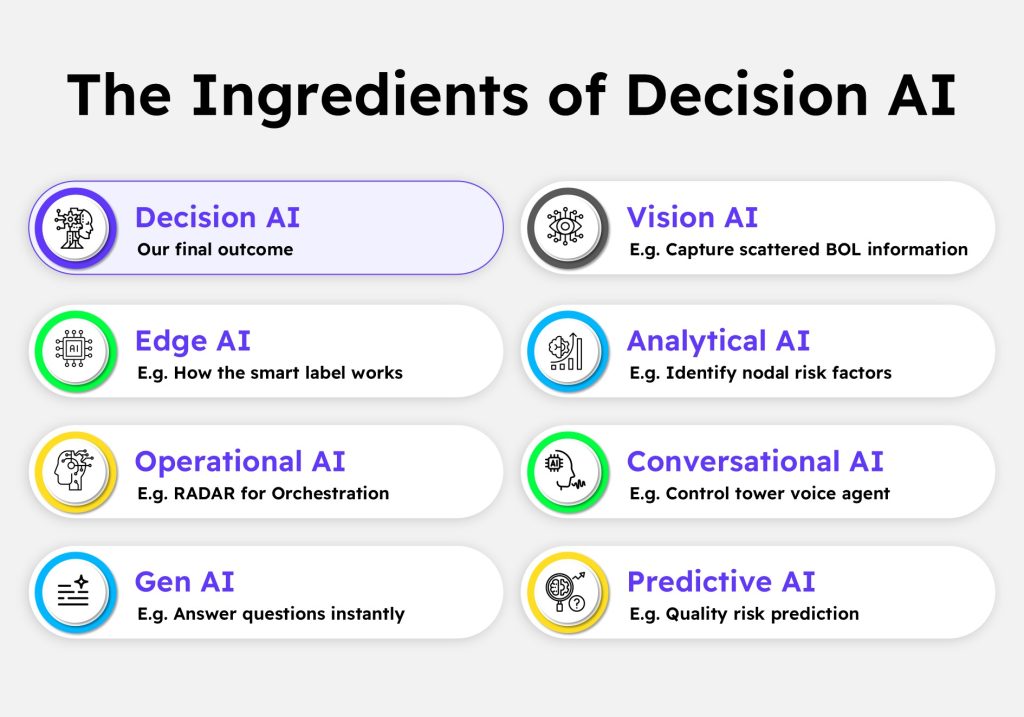
Introduction Supply chain visibility platforms generate constant signals, but most cannot translate those signals into decisions. Decklar’s architecture closes this gap with eight types of
Organizations don’t just need drones, bots, or AI to scale fast and steady. They need people who seek, see, and seize the opportunity to do things differently to rise above the status quo.
I recently had a long winding discussion with a Venture Capitalist who was curious about what makes Decklar tick. Since its founding in 2014, Decklar has made a mark in the IoT market. We didn’t begin with millions of dollars in funding, nor did we have hundreds of team members handling things. Despite a frugal foundation, we’ve built full-fledged operations in 7+ countries and have catered to 200+ global enterprise customers. We overcame the inevitable teething problems of a new technology solution, and we took competition from well-established players head-on.
How did we take our operations global with fewer than 200 people? How do we roll out radically new market solutions in a matter of months? What is it that drives such rapid evolution and scale from such a small team?
“It’s simple” I told him; “that’s because we’re Responsible Rebels”.
Work culture is the most important catalyst for a company’s success. Just like Facebook has a “Hacker” culture, and Netflix built a culture of “Freedom and Responsibility,” Decklar has its own unique culture that fosters rapid innovation and growth.
At Decklar, we believe in people who love to innovate and positively disrupt everything. We thrive on people who rebel against the norm, people who challenge the status quo, people who don’t just follow a process because “it’s how things are done around here”.
We are rebels, Responsible Rebels
Let’s break that down.

They’re dependable, trustworthy, they know what to do, stick to their tasks and see things through. Responsible team members are the solid foundation that successful enterprises run on.
A responsible team member follows a company’s rules and processes to the letter.
Whether it’s hitting targets, meeting expectations, or taking ownership for their actions, they’re the dependable shoulders that stable organizations are built on.
“Dependable” is what most organizations look for. But is “Dependable” enough? Organizations built solely on a dependable workforce will stagnate.
Without people who think outside the box or color outside the lines, organizations could go years, even decades, doing things exactly the same, without ever wondering if there’s something better out there.

They’re the black sheep that can’t follow the rules, they challenge the status quo and define their own way. They flout the norms and are often let go, because they’re not ‘team players’.
“Rebels” on the other hand are team members that question the status quo. They think differently, innovate, bring new concepts and methods to the mix. They catch flaws that hide in everyone else’s blind spot, and they improve the odds of success by stress-testing the logic behind everything.
They live life outside the box, they color outside the lines, they define their own way.
Managers and HR departments in most companies often struggle with them. Rebels are often misunderstood, they’re the black sheep that can’t follow the rules. They flout the norms, they get into heated debates that can spiral into arguments. Rebels are often let go because they’re “not team players.” They jump from organization to organization because they just don’t fit the template that companies treasure above everything else. Whether their opinions and ideas add value is beside the point.
Some of the world’s biggest companies — Uber, or even the old Apple that Steve Jobs set up (before his unceremonious exit) — nurtured these qualities. These companies thrived and disrupted the market precisely because the person at the helm rebelled against the norm, dreamt big, and did things differently. Still, many of these companies bore the brunt of their rebellions at later stages in their journey. Things took an ugly turn, and many believed it could all have been avoided if the upstarts acted just a bit more “responsible.”
An organization full of responsible people will hold steady, grow slowly, but eventually fail. If the rise and fall of companies like Kongō Gumi, Kodak, Nokia, or Yahoo has taught us anything, it’s that companies that don’t adapt to change, don’t stand a chance. An organization full of rebels wouldn’t work either, things would be too turbulent to get anything done.
Is there a way to balance the mix of “responsible” and “rebellious”?
A Responsible Rebel at Decklar questions everything, digs deep for every decision, and always has a bigger picture in mind. We don’t think rules or processes are draconian, we see them for the positive discipline and structure that it brings to help us realize the bigger picture.
But, if the rules or processes don’t help achieve our ultimate goal, we are sure to rebel against them.
A Responsible Rebel is also someone who is self-motivated and sees things through to completion, without any prodding.

Responsible Rebels don’t make long-term thinking the boss’ job.
They’re just as invested as the CEO in how the company will survive and thrive today, or five years from now, because they take the time to understand the big picture and purpose — and what it means for their professional and personal lives. With a proper purpose established, every action, every milestone aligns toward achieving that purpose. It’s not about disrupting existing processes for the sake (or fun) of it; rather, it’s to achieve a specific well-defined outcome.
Responsible Rebels never shy from questioning the status quo.
They never follow instructions blindly just because someone told them to do it. They’re going to want to see the logic before they comply.
For example, when the world was convinced that tracking a fleet was the best approach to smart logistics, we questioned it. We took a bold new “connected things” approach for better tracking and supply chain visibility instead. That’s because we saw that nearly 80% of freight is shipped using third-party transportation, not on self-operated fleets, which inspired us to build and deploy the market’s first on-demand shipment-level monitoring solution in a matter of weeks.
Responsible Rebels have data and facts to back them up.
They always have a good reason for anything they propose, which is why they know it’s worth it, and within the realm of doability. Whatever the change, there must be some valid and acceptable reason behind it. They’re passionate about what they do, and how the change will work, and how it’ll work with others. They’re guided by data and a generous measure of common sense. If the data doesn’t add up, they’ll drop the argument without a fuss.
Responsible Rebels embrace “anything new” willingly.
They are not afraid to drop the dogma for something that can get the same results faster, and with fewer resources. They are obsessed with making the best even better, and they revel in a sense of accomplishment from raising the bar even higher.
When we saw the challenges that well-established inventory tracking systems like RFID posed in terms cost and scalability, we were one of the first to adapt Bluetooth and Nb-IoT to build a better alternative in this space. In this process, we were also the first to bridge the gap between indoor, outdoor, and in-transit item-level monitoring.
Responsible Rebels respect hierarchy; but they still find the best way to get a job done.
They’re not satisfied taking the same path to the same end every day, not if there’s a faster way to get there. They’ll review processes, figure out the kinks, and find faster ways to get from point A to point B without cutting corners.
When we were setting up a complete IoT supply chain tracking and management solution, industry experts and leaders advised Decklar to stick to one thing, get it right, and do it well.
We questioned that advice.
We bit the bullet and didn’t confine ourselves to just one area of expertise. Instead, we pioneered our own hardware, our own software, built data scrounging and analytics algorithms from scratch, and put together the building blocks for an automated supply chain intelligence suite and a Network Operations Center (NOC), all using in-house experience and expertise. This was a game-changer — it gave our customers a one stop shop for all their supply chain monitoring and management needs.
Responsible Rebels are realists, they thrive on constructive criticism.
They’re not blind to the signs of disarray, and they’re open to the possibility of failure. They even welcome it, recognizing the valuable lessons and opportunities for improvement in failures.
Responsible rebels aren’t shy of asking for help, neither do they shy away from accepting responsibility or critical feedback. In fact, they count on it to improve ideas or validate them beyond question.
Responsible Rebels always think of scale.
They don’t just work well solo, they’re also looking for partners in crime. They may go against established norms, but they don’t always go at it alone. They encourage others who are set in their way, especially people who aren’t fond of change (yeah, there’s always one) or people that don’t take to innovation readily. They understand that innovation, improvement, and progress don’t happen in silos. It’s an “all or nothing” kind of deal. They take the time and make the effort to get the majority’s buy-in, involving the team, their superiors, the colleagues, even getting the customers, partners, and vendors in on it. They recognize and rope in everyone that’s vital to speeding up the collective success story.
Decklar does whatever it can to encourage and enable our Responsible Rebels.
Every team and individual has the freedom to build their own set of goals, with just one condition — their goals need to align with those of the organization.
Every individual has the opportunity to ask “Why?”, till they are convinced.
If you are a team manager, you have individual KPIs, apart from your collective team’s KPIs at Decklar. The beauty of this arrangement is that there’s lesser incentive to manage, and a bigger call to mentor.
At Decklar, every individual is nurtured to bring out the rebel in them. We still give them a semblance of structure and discipline however, just enough that the right processes and cohesion are maintained to deliver at scale.
The responsibly rebellious culture has carried us to where we stand today, and we believe it’ll take us to the pinnacle of success in the coming years!

Introduction Supply chain visibility platforms generate constant signals, but most cannot translate those signals into decisions. Decklar’s architecture closes this gap with eight types of

Global supply chains operate under constant disruption driven by geopolitical volatility, congestion, climate risk, and multi-tier complexity. While control towers have improved visibility, most still depend on manual intervention, static rules, and delayed response.

Supply chain visibility platforms generate constant signals, but most cannot translate those signals into decisions. Decklar’s architecture closes this gap with eight types of AI that work together to interpret, predict, and act in real time. Each AI pillar plays a distinct role, but their true value emerges when they operate as a unified decision engine.
Michael, through his company CABOA GmbH, is a senior executive advisor to DTCP’s Growth Equity business with more than 20 years of international experience in venture and growth capital, and private equity. In total, he has been responsible for funds with a volume of up to €750 million, invested in more than 40 start-up companies worldwide, and realized more than 30 successful exits. He supports companies mainly in questions of incorporation, funding, and exit – with a special focus on Europe, the USA, and Israel. He speaks the language of investors, start-ups and large to medium-sized companies and ensures sustainable success with his entrepreneurial thinking and acting.
Prior to his current role, Michael was Managing Director in DTCP’s Europe-based growth capital team and before that, Managing Director at T-Venture where he focused on disruptive wireless, deep-tech, and infrastructure investments. Earlier in his career, he worked as Senior Consultant at Detecon International, as Product Manager of the German fixed network operator o.tel.o Communications, and founded his own company.
Michael holds an M.Sc. in Economics from the University of Wuppertal, Germany.
Meenakshi Singh is a Silicon Valley veteran with more than 30 years of experience in corporate finance, leadership, and management, mergers and acquisitions. She has been through a merger or acquisition 15+ times and has the unique ability to be able to view the exit strategy from both sides of the table. In her role as Decklar’s CFO and Board member, she oversees financial operations of Decklar and its foreign operations.
Meenakshi was the founding CFO of many technology companies including Apigee (NASDAQ: APIC), Cortina Systems, (acquired by Inphi Corporation), Ankeena Networks (acquired by Juniper Networks) and StratumOne, acquired by Cisco Systems and where she was an executive in the Mergers & Acquisitions team.
Crystal is a Principal at Reefknot Investments, a Venture Capital fund focused on investing in Supply Chain and Logistics technology startups globally.
Crystal brings over 10 years of investing experience executing VC/PE, M&A, JV and Greenfield investments globally across diverse industry sectors, including transportation, logistics, financials and food/natural resources. She was formerly with the global M&A team at Louis Dreyfus Company with a focus on Asia and Middle East / Africa deals. Crystal was also previously with Momentum Ventures, the corporate venture arm of a leading transport operator, overseeing investments and facilitating the adoption of innovative technology and business models within the corporate.
Crystal also serves on the Singapore Venture & Private Capital Association (SVCA) VC Sub-committee.
George is a distinguished leader in the finance and business community in Silicon Valley and the broader United States, with over 35 years of experience. He has held pivotal roles such as COO, CFO, and CEO at renowned organizations, including Pluribus Networks, Marvell Technology, Chordiant Software, Remedy Corporation, and Aeroprise, Inc. He has navigated an impressive track record of IPOs, substantial M&A deals, and capital-raising ventures, amounting to over $½ billion.
Starting his career as a CPA in the big-four accounting industry followed by subsequent executive roles, George possesses extensive board experience, notably as Chair of the Audit Committees at Bridgelux, Inc., Vendavo, Inc., Saba Software, Inc., GCT Semi, Inc., Rainmaker Systems, Inc., and Montalvo Arts Center. George was also appointed a member of President George Bush’s National Information Technology Advisory Committee. Currently, he serves as a Director of HeartBeam, Inc., a publicly traded medical device company, where he chairs the Audit Committee and is a member of the Compensation Committee.
George’s career highlights include his tenure as CFO for Remedy Corporation, which was recognized as the “#1 Hot Growth Company” in America by Business Week. He has spoken at Forbes magazine’s annual CFO conference, authored multiple articles, and been featured in The Wall Street Journal’s “CFO Journal.” He has delivered guest lectures at prestigious institutions like the University of California at Berkeley, Cambridge University in the UK, and Baylor University.
George holds a Master of Business Administration from the University of California at Berkeley and a Bachelor of Science in Accounting/Business from the University of Southern California.
Dweep has over 10 years of experience advising or investing into companies across the growth cycle in Industrial IoT, financial services, energy and consumer sectors in US, Europe, and Asia.
He was previously Head of Venture Investments at Momenta Partners, where he led 7 industrial IoT investments. Previously he was Managing Director at Touchstone Ventures, a direct investment firm advising family offices on growth-stage investments, served as Director, Strategy and Business Development for Family Services at UBS Wealth Management, and led a UN financed market entry and financing program in Kenya.
A telecommunications engineer by training, he worked for over 6 years with Lucent and Hughes. He has worked in India, USA, Kenya, and China, and is currently based in Switzerland.
Deepak is a Senior Investment Manager at Qualcomm Ventures focusing on US investments. He is responsible for sourcing, deal execution and portfolio management. He brings 5+ years of investment experience across early to growth stage companies, combining his tech background with his passion for investing.
Before joining Qualcomm Ventures, Deepak was part of the founding team at the GPO Fund, NY based tech-focused investment firm, where he led several enterprise tech investments such as MapAnything (acquired by Salesforce). Prior to this role, he worked at Unilazer Ventures, investing in several successful consumer tech companies such as Lenskart. He has also worked at The Carlyle Group and Soros Fund Management as part of their investment team.
Deepak earned his MBA from Columbia Business School and a Bachelor of Technology in Computer Engineering from VJTI, Mumbai.
Nitesh Mandal is a logistics transformation leader with more than 15 years of experience driving supply-chain efficiency and digital innovation for global enterprises. At Decklar, he leads sales and account management, helping Global 2000 enterprises implement Decision AI in their supply chains.
Prior to joining Decklar, Nitesh held global leadership roles at Maersk, most recently as Head of Growth, Strategy & Solution Design. He had P&L responsibility for warehousing, logistics, and supply-chain optimization solutions across retail, CPG, technology, and chemical sectors.
Throughout his career, Nitesh has combined strategic leadership with deep domain expertise across transportation and warehousing in India and Europe, bringing a hands-on approach to supply chain transformation.
He holds a Master’s degree in Logistics and Supply Chain Management from Lancaster University, UK, along with CLTD and CSCP certifications from APICS. Outside of work, Nitesh is passionate about cricket and community-building, drawing leadership lessons from sport—teamwork, discipline, and adaptability—that guide his approach to business and people.
Pankaj is an inventor with numerous patents across satellite communications, IoT, biomedical devices, and digital signal processing, with a track record of commercializing his inventions into real-world products. At Decklar, he is the Chief Scientist and Vice President of IoT Research and Development, responsible for leading new product innovations, solutions, and IP for a broad range of IoT applications.
Before Decklar, Pankaj was Founder, Lead Researcher and Chief Technologist at IntelliSys. For more than thirty years, he has focused on developing key technology and IP, then taking it into the market as successful external ventures and partnerships. These included three security products companies sold to Ademco (a division of Honeywell). In addition to Ademco, other key technologies were developed/licensed to Fortune 500 companies like Panametrics (GE & Olympus), Emerging Market Communications (Global Eagle Entertainment) and Aware Inc. Pankaj worked at Panametrics in a variety of leadership and scientific capacities and was critical in making Panametrics #2 in the world. He was the Founder and CTO of Biometrics fingerprint security company that had an IPO. Recently, he was instrumental to two Silicon Valley start-ups, RiskVision and Aceurity, in developing their key technology, solutions, and teams.
Pankaj holds Masters Electronics Engineering from Worcester Polytechnic Institute, Massachusetts (USA), a Bachelors degree in Electrical Electronics from Sardar Patel University, India, and is GE Six Sigma for Software. Outside of work, he enjoys the outdoors and cars.
Premsai Sainathan (Prem) is an engineer-turned growth executive with 15+ years of entrepreneurial and market-building experience in high-tech. At Decklar, he leads the company’s global go-to-market (GTM) strategy, demand generation, and category expansion in Decision Intelligence—spanning brand and communications.
Prior to Decklar, Prem co-founded Skope Solutions, an IoT-enabled indoor positioning startup known for fully managed solution deployments in supply chain. Earlier in his career, he built mechanical components for the NSF-backed LIGO gravitational wave research program and delivered manufacturing supply chain improvements at Packaging Corporation of America (PCA).
A recognized speaker and published author, Prem has been featured in platforms including Supply Chain Digital, Supply Chain Brain, Modern Materials Handling, CII, BITS, and Global Logistics Show. Describing himself as a “functional marketer,” he excels at developing and executing GTM playbooks that build high performing demand engines and generate multi-million-dollar revenue within months of launching in new markets.
Prem holds a Master of Science in Mechanical Engineering from the University of Florida (USA) and a Bachelor’s from Anna University (India). Outside of work, he mentors founders and emerging leaders on a conscious leadership philosophy rooted in spirituality. He also enjoys practicing martial arts, music, and meditation.
Vidya Subramanian is a supply chain technology executive with 25+ years of experience innovating, building, and scaling enterprise platforms. At Decklar, he advances next-generation AI capabilities across the embedded, communications, data, and analytics layers to power the supply chains of the future.
Before Decklar, Vidya was co-founded KeyTone Technologies Inc., an RFID technology company focused on real-time asset monitoring in supply chains with a successful exit. He has held leadership roles at Plexus Technologies Inc., KPMG Consulting, Unisys, and PriceWaterhouseCoopers (PwC). He holds multiple patents across embedded data collection and signal enrichment, helping enterprises separate noise from actionable operational signals.
Known for cutting through complexity and guiding teams to practical solutions, Vidya is a trusted advisor to customers—bringing clarity, rigor, and creative problem-solving. His incisive and practical perspectives on supply chain transformation have been featured in prominent outlets such as Supply Chain Brain, CSCMP, and ABC News. He was featured among the “Supply Chain Pros to Know” by Supply & Demand Chain Executive.
Vidya holds a Master’s degree in Computer Science from Temple University, USA and dual Bachelor’s degrees in Computer Science and Economics from Calvin College (Michigan), USA. Outside of work, he enjoys golf and has a passion for cooking.
Shailesh Mangal is a hands-on technology leader with 20+ years of experience designing and scaling enterprise applications and intelligent platforms. At Decklar, he leads the architecture and engineering of the company’s Real-Time Decision AI platform—architecting systems that convert data into reliable, actionable decisions while maintaining performance, scalability, and trust.
Before Decklar, as CTO / VP Engineering at Zephyr (SaaS Quality Management Platform, acquired by SmartBear), he built disciplined, high-output engineering orgs from the ground up—implementing SLOs, CI/CD pipelines, reliability guardrails, and first-principles systems design that drove efficient delivery and a successful exit.
He designs AI-native enterprise systems from first principles: layered, event-driven architectures that integrate real-time streaming ingestion of heterogeneous IoT and telemetry signals, and long-horizon, self-enriching contextual data lakes accumulated from more than 10 years of visibility transactions. These systems include adaptive, multi-modal inference pipelines that enable sub-second autonomous decision orchestration at petabyte scale.
Shailesh holds a Master of Science in Information Technology from the University of Texas, (USA) and a Bachelor of Engineering from MNIT, Jaipur (India). Outside of work, he’s an avid runner and hiker who enjoys exploring new trails, great food, and building things that endure.
Jigna Yagnik is a growth-focused finance leader with 20+ years of experience building strong financial systems for scale-ups. At Decklar, she leads data-driven planning, operational rigor, and governance—building the financial foundation for the company’s AI-driven expansion.
Prior to Decklar, Jigna built the finance and audit practice at Booz & Co, led its M&A, and post-merger integration with PwC. From automating operating metrics and forecasting to driving capital efficiency, she ensured finance acts as a lever for acceleration—not just control. Her strategic initiatives have included expansion in new markets, capital raising, and investor relations.
Throughout her career, Jigna has partnered closely with leadership teams—translating financial strategy into actionable operating plans that drive sustainable growth across geographies and verticals.
She is a CFA, CA and has an MBA in Finance and Strategy from the Indian School of Business (Hyderabad). Outside of work, Jigna mentors finance professionals on moving beyond theoretical models to adaptive, insights-driven finance functions that scale with the business.
With extensive experience providing legal and business guidance to technology, cloud, software and service companies in outside and in-house positions, Frank I. Hoppe serves as Decklar’s General Counsel. He is responsible for all aspects of Decklar’s expanding global legal endeavors. Before Decklar, Frank served as Executive Vice President and General Counsel of Kaseya; President and founding member of Hoppe General Counsel Services; Vice President and Assistant General Counsel at West Corporation, and Vice President of Corporate Development at uRoam, Inc. which was acquired by F5 Networks, Inc. He also previously worked as associate counsel at the law firm Wilson Sonsini Goodrich and Rosati, and the law firm Krieg, Keller, Sloan, Reilley & Roman.
In addition to his J.D. from UC Berkeley Boalt Hall School of Law, he received his B.A., with distinction, as an Echols Scholar from the University of Virginia where he served as Chairman of the University’s student-run Judiciary Committee.
Pratik Soni is a global operations and supply-chain executive with 20+ years of experience leading SaaS scale-ups and building technology-driven systems for global enterprises. At Decklar, he is responsible for worldwide operations, vendor management, and customer delivery.
Prior to joining Decklar, Pratik was founder & CEO of Omnichain Solutions, a venture-backed SaaS company focused on mid-market supply chain management platforms. Earlier, he held leadership roles at Apple, Beats by Dre, I.am.+, and 20th Century Fox, where he drove large-scale operations, supply-chain transformation, and global hardware and distribution strategy.
A recognized thought leader in operations and supply-chain innovation, Pratik has authored more than fifty published articles across leading publications such as FreightWaves and Supply & Demand Chain Executive. He also serves as Chair of the Location Data Standards Group at BITA (FreightWaves), which published the industry’s first interoperability protocol for blockchain-based supply-chain networks.
Pratik holds a Bachelor of Science in Business Information Systems and Global Supply Chain and Operations, along with advanced certifications in Lean Six Sigma, CSCP, and CPIM. Outside of work, he is passionate about motorsports and enjoys exploring the outdoors with family.
Dave Ferretti is an enterprise technology sales leader with 25+ years of experience helping Global 2000 companies adopt and scale disruptive technologies. At Decklar, he leads sales and account management.
Dave began his career at Xerox and later built and led sales organizations for five startups that were later acquired. These include TidalScale, (acquired by Hewlett Packard Enterprise), Diablo Technologies (acquired by Rambus), and Skyera (acquired by Western Digital). Prior to sales, he worked in software and systems engineering across satellite communications and medical imaging, gaining deep experience in end-to-end hardware and software integration.
Throughout his career, Dave has helped tech startups commercialize breakthrough technology into proven enterprise value. His consultative approach and technical fluency help enterprises translate innovation into measurable business outcomes.
He holds a Bachelor of Science in Computer Information Systems and Business Administration from the University of Colorado, Boulder (USA). Outside of work, Dave is a certified professional ski instructor. Coaching and mentoring leaders from diverse professions reinforces his belief in confidence, precision, and continuous learning as the foundations of leadership.
Sanjay Sharma is a seasoned technology entrepreneur with more than 25 years of experience building and scaling deep-tech B2B companies from ground up. As CEO of Decklar, he leads the company’s vision, worldwide business growth, increasing its value, and advancing a new era in supply chain Decision Intelligence.
Prior to Decklar, he co-founded and led KeyTone Technologies and Plexus Technologies—both with successful exits. He’s worked in multiple technology roles at NASA, EMC, and Schlumberger. Sanjay holds many patents and has published papers in journals like IEEE, ISCA, and South Dakota Academy of Science.
Sanjay is a familiar voice at prestigious global platforms including Mobile World Congress, TiE, Global Digital Forum, LogiPharma, Red Hat Summit, International Smart Logistics & Supply Chain Conference, and DHL IoT Day. His leadership style centers on continuously retooling and upskilling teams—both internally and across customer organizations—to keep pace with fast-changing technology landscapes.
Sanjay holds a Master of Science in Electrical Engineering from South Dakota State University (USA) and a Bachelor’s from the University of Mumbai (India). Outside of work, he coaches cricket and mentors young professionals, reflecting a leadership style built on long-term thinking and collective growth.