
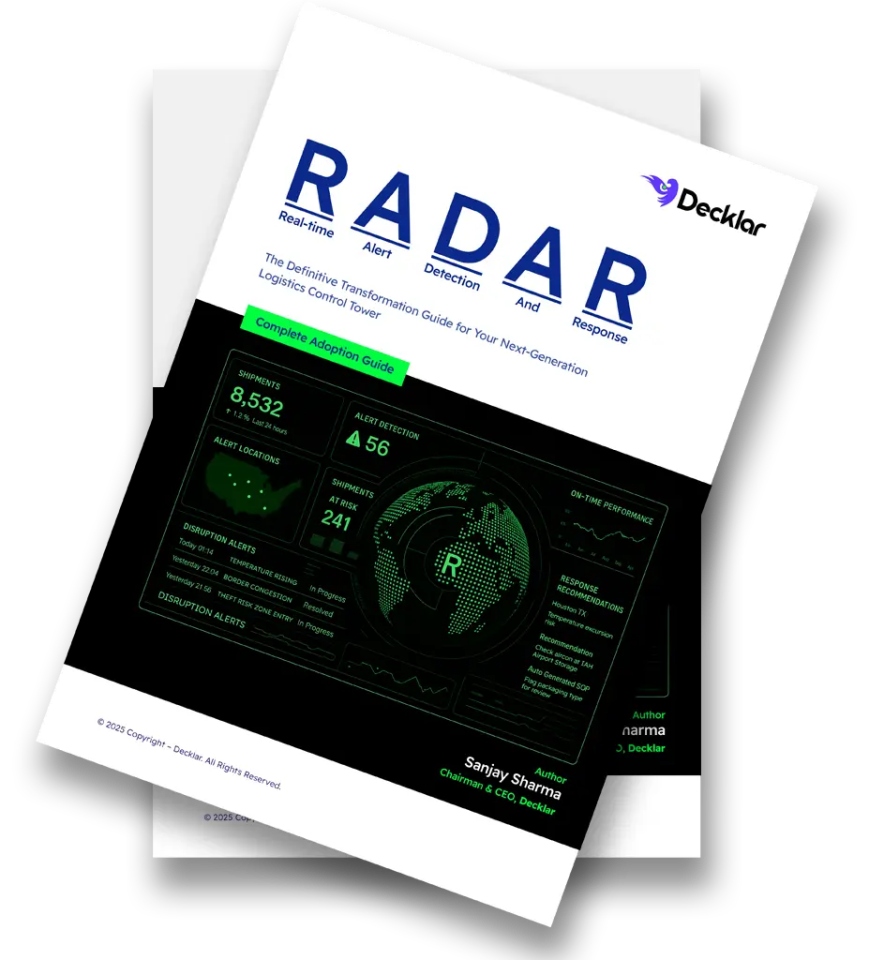
RADAR: The Adoption Guide for Autonomous Supply Chain Control Towers
Overview
Global supply chains operate under constant disruption driven by geopolitical volatility, congestion, climate risk, and multi-tier complexity. While control towers have improved visibility, most still depend on manual intervention, static rules, and delayed response.
RADAR introduces a new control tower model. It functions as an autonomous, self-learning intelligence and execution layer that transforms alerts into prioritized decisions and coordinated action, continuously and in real time.
This guide explains how RADAR upgrades existing control towers into intelligent, self-learning command centers without replacing current systems.
The Problem: Why Traditional Control Towers Fall Short
Most control towers stop at monitoring and alerting. They expose issues but leave teams to interpret, prioritize, and respond manually.
Common limitations include:
- Visibility without ranked actions or policy-driven response
- Fragmented data across tiers with no decision-ready digital twin
- Manual triage queues that cannot keep pace with disruption
- Static rules that do not adapt or learn over time
These gaps prevent control towers from delivering consistent outcomes at scale.
The Solution: RADAR as an Autonomous Control Tower Layer
RADAR functions as an enhancement layer that sits above existing control towers and visibility platforms. It operates on a push-based, real-time architecture that combines human judgment with machine prioritization.
With RADAR, organizations can:
- Detect and prioritize risks continuously across modes and tiers
- Convert alerts into ranked, context-aware recommendations
- Enable autonomous execution of predefined workflows
- Coordinate responses across partners, carriers, and internal teams
- Improve outcomes without rebuilding or replacing current systems
RADAR augments foundational visibility with intelligence, orchestration, and execution.
Why It Matters
As disruption frequency increases, response speed and decision quality become critical differentiators.
This whitepaper shows how RADAR enables organizations to:
- Move from reactive monitoring to proactive orchestration
- Reduce manual workload through autonomous, self-learning AI agents
- Anticipate and mitigate disruption through global trade lane risk analysis and scenario-based response planning
- Enable multi-tier collaboration beyond immediate partners
- Scale decision intelligence without increasing operational overhead
Instead of managing alerts, teams focus on higher-value decisions while RADAR manages execution in the background.
What the Guide Covers
This adoption guide provides a structured, architecture-level view of:
- The evolution of supply chain control towers
- RADAR’s role as an intelligence and execution layer
- Core architectural principles and integration approach
- AI-driven alert detection, prioritization, and response
- Global trade lane risk analysis and scenario planning
- Industry use cases across manufacturing, logistics, retail, and life sciences
- Patterns for adoption without disruption to existing infrastructure
All content is designed for leaders responsible for control tower strategy, operations, and transformation.
Who Should Read This Guide
- Supply chain and logistics technology leaders
- Control tower owners and operators
- Enterprise IT and operations teams
- Digital transformation and AI leaders
- Manufacturers, retailers, and logistics providers managing complex networks
The guide includes industry-specific perspectives across electronics and manufacturing, automotive, retail and consumer goods, logistics and transportation, and regulated sectors such as pharmaceuticals and medical devices, where compliance, cold chain integrity, and disruption response are critical.
Authored By

Dave Ferretti, Vice President – Sales, Americas
Dave Ferretti leads enterprise sales at Decklar. With a track record of driving sales for AI/ML first-mover solutions, Dave has built sales processes at five startups acquired by Fortune 500 companies. He brings deep expertise in software systems engineering and federal security clearances.

Premsai Sainathan, Vice President – Growth
Premsai Sainathan drives scalable demand generation and go-to-market strategies at Decklar. A seasoned entrepreneur, Premsai co-founded IoT firm Skope Solutions and has been instrumental in establishing product-market fit in key markets. He is a published author and frequent industry speaker.
Download the Guide Now
Build a control tower that detects risk, prioritizes action, and responds autonomously.